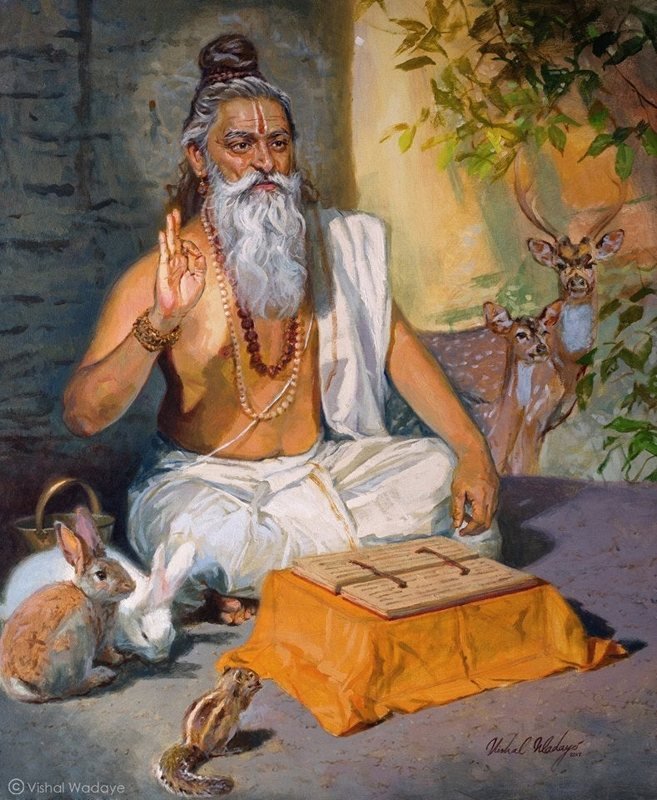
Yoga Vāsiṣṭham — Sage Vasiṣṭha’s Teaching to Śrī Rāma
As a young prince of about sixteen, Śrī Rāma returns from a pilgrimage across the land and falls into deep dispassion. He sees the impermanence of the body, of wealth and of the world, and loses all interest in life. When Sage Viśvāmitra comes to Ayodhyā to take Rāma to protect his yajña, Rāma’s condition is described to the assembly. Viśvāmitra asks Sage Vasiṣṭha, the royal Guru, to lead Rāma to Self-knowledge. What follows — told through dialogue and many stories — is the Yoga Vāsiṣṭham, one of the most complete works on the nature of mind, the world and liberation.
Studied with the Bhagavad Gītā. In the Bhagavad Gītā, Bhagavān as Śrī Kṛṣṇa is the Guru who teaches His devotee. Here, the same Bhagavān as Śrī Rāma becomes the disciple and learns from Guru Vasiṣṭha, showing the world that even one who knows everything must learn from a Guru. Both are the play of Śrī Viṣṇu, for us to learn and to teach.
| Author | Maharṣi Vālmīki, author of the Rāmāyaṇa |
|---|---|
| Teacher and disciple | Brahmarṣi Vasiṣṭha teaches Śrī Rāma in the court of King Daśaratha, with Viśvāmitra and the sages present |
| Frame | Vālmīki narrates the dialogue to his disciple Bharadvāja |
| Yuga | Tretā Yuga, before Rāma leaves with Viśvāmitra (the events of the Bāla Kāṇḍa) |
| Other names | Mahā-Rāmāyaṇa, Ārṣa Rāmāyaṇa, Vāsiṣṭha Rāmāyaṇa, Jñāna Vāsiṣṭha |
| Size | The full Bṛhat (great) Yoga Vāsiṣṭha has about 32,000 ślokas in six prakaraṇas. The Laghu (short) Yoga Vāsiṣṭha, abridged by Gauḍa Abhinanda of Kashmir, has about 6,000. |
| Philosophy | Advaita Vedānta, taught through experience and stories rather than argument; it gives a central place to self-effort (pauruṣa) and to inquiry (vicāra) |
| # | Prakaraṇa | Subject |
|---|---|---|
| 1 | Vairāgya — dispassion | Rāma’s despair and his searching questions about life |
| 2 | Mumukṣu-vyavahāra — the seeker | The qualities of the seeker; self-effort over fate; the four gatekeepers of liberation |
| 3 | Utpatti — creation | The world as a projection of mind; the story of Līlā |
| 4 | Sthiti — existence | How the world is sustained by mind; stories such as Śukra’s |
| 5 | Upaśama — quiescence | The stilling of the mind; the stories of Janaka, Prahlāda and Gādhi |
| 6 | Nirvāṇa — liberation (in two parts) | The state of the liberated; the stories of Bhuśuṇḍa, and of Cūḍālā and Śikhidhvaja |
The four gatekeepers of liberation
At the start of his teaching Vasiṣṭha tells Rāma that the gate of liberation has four keepers. If one of them is befriended, he brings in the other three.
Śāstra Pramāṇa — the scriptural authority
Yoga Vāsiṣṭham 2.11.59 (Mumukṣu-vyavahāra Prakaraṇa)
mokṣa-dvāre dvāra-pālāś catvāraḥ parikīrtitāḥ
śamo vicāraḥ santoṣaś caturthaḥ sādhu-saṅgamaḥ
Four gatekeepers are declared to stand at the gate of liberation: peace of mind (śama), inquiry (vicāra), contentment (santoṣa) and, fourth, the company of the wise (sādhu-saṅga).
Why it matters
The Yoga Vāsiṣṭham has been loved by seekers for centuries. Śrī Ramaṇa Maharṣi recommended it. The Yoga Vāsiṣṭha Sāra distils it into about 230 verses, and it has been translated into Tamil, Malayalam, Bengali, Persian and other languages.
Modern academic dating: Modern scholars date the present Yoga Vāsiṣṭha between about the 6th and 14th century CE, many placing its final form around the 11th–14th century, and regard the Laghu version as an abridgement of it. This is given for information; the traditional account above is the Gurukulam’s basis of teaching.
📜 Coming next: the scripture text itself — selected chapters with transliteration and meaning — will be added to this page in the next phase.
Sources & where to read
- Yoga Vāsiṣṭha — Sanskrit text with English (verse 2.11.59) — wisdomlib.org
- The Yoga-Vasishtha Maharamayana, tr. Vihari-Lala Mitra (1891–99) — Project Gutenberg
- Laghu Yoga Vāsiṣṭha, tr. K. Narayanasvami Aiyar (1896) — wisdomlib.org